Feed on
Posts
Comments
Note the ragged sword edge for additional damage

You shall not pass? Please?

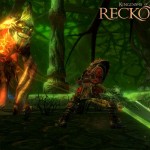
Sometime I find myself guilty of procrastination. Who isn’t? Finding thousands of little things to do instead of the one you should be doing? And suddenly your apartment is cleaned up after years of neglect – on finals week. This is why I somehow found time to have a look at the demo for Kingdoms of Amalur: Reckoning. And the demo looked back at me and offered some insights.

Let’s start with the setting and some production background. Because the latter gives context to my criticism on the former. Which is: I don’t feel it. You see, the whole game is allegedly intended to be part of a larger franchise and a kind of proof-of-concept for a larger MMO project. And it seems to have the necessary money behind it, as well as some promising names like Ken Rolston. It’s just… look, I started the game and was greeted with a, well, quite standard RPG intro. The unique point would be that everything somehow is coated in Celtic mythology. Which I find funny, because I did something like that in a student project some years back. And ended up with the same problem that haunts KoA:R. Which is, no one understands the names or will be able to spell them. Or, you know, at least have the option “Subtitles” turned on as default. Really, as non-native speaker I got confused halfway through the intro about the narration. Who was that? Did I just mishear a genuine English word or was that the name of some guy I should supposedly remember? That, combined with the fact that the plot summarizes to “Evil army threatens the world” killed my attention to the setting halfway through the introduction.

Stop me if you heard that one before…

Tuatha Dé Danann versus the Fomori, if I remember correctly

Shouldn't the "Tuatha" be the Good Guys?

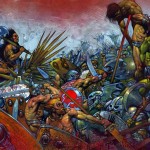
The other thing that amuses me about the setting is, well… see the picture on the right? It’s from Sláine, an 80′s comic based on Celtic mythology. If you do anything with that setting, you will at one time or other reference it. The walls at 38 Studios are probably cluttered with illustrations from that comic and their own concept art. The fun part? Sláine was a contemporary to Warhammer Fantasy. There obviously was something about 80′s Britain that produced a certain mindset of dark and gritty. So, the joke is Tatcherism gave is some of the best works in fantasy and comics ever? Probably, but I like the following timeline more: “An lo! Warhammer met Dune 2 and they begat Warcraft. And Warcraft met Everquest and they begat World of Warcraft. And World of Warcraft met Oblivion and they begat Kingdoms of Amalur. And they all lived in one house and shared their food and continued to beget children with each other.”

What I am trying to say is: It’s only of medium originality, since gamers stewed in that particular setting soup for generations now. Which is not a bad thing, concerning it’s intended mass appeal as MMO.  But at least I can no longer muster the necessary excitement that you would want from me if I were to invest in your franchise. Which is the first insight I gained from this game: My comfort zone of “fantasy stuff” is already pretty filled up. And I require new entrants to bring in something new and interesting to the table.

But… is the game any good?

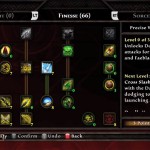
You are practically unlocking stuff that happens when you press "Attack"

Tank, DD and... where is the Heal?

Well, kind of. It’s a weird mixture of MMO and Singleplayer Game, with questing and crafting from the former and combat from the latter. But without other more compelling elements like other players or a unique story. Ok, I could be wrong on the story. It really tries to give you something there. It just felt very disconnected, with no background or context for my character and the far too soon opening up the plotline  into generic questing content. But I’ll concede that criticism to the demo and take a final stab at game mechanics.

The game offers the three default classes Warrior, Mage, Rogue and prides itself of its powerful and flexible talent tree and customization system. And the way it works is: There are three trees, and on levelup you choose where to put your points. And there are Destiny Cards that give you a defined class but are only available when you meet their point requirements in every tree. This sounds interesting in concept, but I had problems seeing the interesting choices. The dominant strategy would probably be to pick a single class and put all points in that tree to unlock stronger versions of that class. Most talents give you additional weapon moves. But in combat you are restricted to two weapons anyway, so why should I learn a bit of everything when I am not allowed to put everything into practice? Plus, I did not see any differentiation within each tree. A Warrior is a Warrior, there seem to be no different builds like, for example, Dragon Age where a Warrior could specialize into tanking or damage. I am not sure if such choices are present in Kingdoms of Amalur. Or even worse, if they are false choices, being present but making no differences.

Pavlov’s Rogue

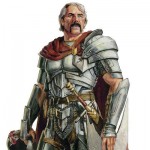
...and he is not even wearing leather

Rogues get all the girls

Nevertheless, I had fun while playing. Will probably get it down the line, just to check my assumptions on the talent tree. And find out how powerful that system can get.
And of course I picked the Rogue. Because I want to get all the loot, hide from foes and gain extra experience just for opening doors, and waitaminute…

That is the second insight I gained from this game: I hate missing content. And I hate dying or otherwise losing playing time. Which revealed to me the self-manipulation that hase been going on for years. I have been conditioned by lots of previous RPGs towards a certain playing style (Rogues) in RPGs that does not necessarily bring me the most fun (that honour goes to Mages), but that avoids the most pain. Really, you have all the benefits of extra equipment, damage avoidance and doing something all the time instead of waiting for mana to refill.
Alright, I’ll chew on that another time, the text is already long enough. And, really, I need to check my feelings and have a long talk with Bioware.

A large part of my job is to write, re-write and give feedback on game design documents. I also give lectures at a private school with game design classes. And there is a bunch of beginner mistakes that I often see from students and design interns.

Creative instead of technical writing

...because it also illustrates typical art drawn by game designers

Great image for Creative Writing

There might well be a place for you to vent all that creative energy. You could take up pottery or painting as a hobby. Just don’t try to build your professional game design career on that one cool D&D campaign you DMed with your friends. Hell, even the game documentation that resembles regular Pen & Paper sourcebooks the closest – World and Style guides – still requires you to be primarily structured, comb out the filler words and get the information across.
This whole posting could be summarized into “It is TECHNICAL writing, stupid!” and some links to freely available, excellent online guides on the topic. Seriously, there are huge differences between a game writer and a designer job. And if the application you replied to clearly states “looking for designers”, then do not try to sell yourself on your awesome creative writing and that fanfic you wrote months ago.

Confusing documentation types

Surprise! There are a lot of different documentation types when designing games. All of them have specific purposes and audiences. A pitching document, for example, is used to sell a project to potential investors. So, yes, you are allowed to use some marketing speech and even drop the occasional “epic” and “awesome”. It should be clear and to the point, and consist not solely of a detailed description of your background story and characters. A “Detailed Design Document” or whatever you call your main rulebook should contain just that: The rules of the game. Ideally in a way that is easily understandable by developers and producers. They care less about the intricate happenings in you game’s universe last centuries.

Inconsistency

So, yes, from now on I will allow myself more variation in the blog layout

Can you spot it?

This beginner’s mistake usually comes in two forms: Inconsistency of layout and inconsistency of content. The first one creates a rag-tag look of document pages that forces readers to slowly scan the whole page and figuring out where the bit of information they need is placed this time. This can be avoided by establishing strict templates and formatting rules.
Inconsistency of content usually happens when no design glossary and structure is present. Suddenly, you got five different names for the same object, designers argue about semantics and every time you ask someone “What ‘resources” exactly?” you get a different answer. This is even more pronounced when the documentation is not written in your native language (yes, we are writing documentation in English but talk is still German). Some English terms get rapidly over-used, since the synonyms are not easily available to all readers. A glossary may help, but ultimately you need really good communication between team members or everyone will stay in his own definition spaces.

Over-specification

Do not put your balancing values into the design doc. Ever. It’s alright to give some indicators like “[few] hitpoints or [max] level”. It’s also good to include relations like “this item type is stronger than all the others” but avoid precise numbers. The reason should be obvious: You will never be able to keep your design document up to date.  Just accept it. The moment you start tweaking your game values, you create false information in your documentation. This could be overlooked if not for one caveat: If THAT information is false, what about ALL OTHER information on that page? You just made your audience disbelief your documentation in general. If you are a social person that can be nice, since now every developer will come to you to ask about the “correct” feature status instead of trusting the doc. Unfortunately, answering these questions all day will keep you from doing any other work you had scheduled.
Concerning work: Over-specification creates a lot of text that gets obsolete very fast. When you hit production phase, the priorities shift and features are iterated. And while that won’t be much of a problem for style guides and feature targets (and those shouldn’t change once production has started, right?!), detailed information does not survive when hit by production reality. Your only chance is to create living, flexible documents without week-long feedback and approval cycles. Mindmaps are very useful for this. That way you can keep up with production and iteration speed and give your developers precise and current implementation information.

Trying to solve everything in text

...because I can not understand it even before starting to read

See, already better than having to read all that in running text

It’s the old “show, don’t tell” maxim. Sometimes it is enough to put a nice image in the header area of a page, so readers can more easily identify the topic. Apart from this visual anchor, images can greatly improve the readability of a feature descriptions. Take this example: “…then the player clicks on a button and a popup asks him if he really wants to pick his nose. If he has enough resources left, the ‘yes’ button is available, otherwise it is greyed out. The ‘no’ button is always available and will either close the popup or show a security popup to confirm his choice if his booger level is already at 23%, in which case…”. After how many words did you space out? How many different cases could be coming that modify the previous sentence?

The above information can be easily communicated with a flowchart. And concerning flowcharts, please stick to these basic guidelines:

  • No excessive use of colour and form. If you have to, include a legend and use it consistently.
  • Make straight arrows, nothing diagonal or curved.
  • Put the start of the chain in the top left corner (or wherever your regional reading customs usually start scanning a text).
  • Do not put additional descriptions in the chart. It should be self-explanatory without much reading.
  • Avoid uncontrolled growth. Charts tend to contain a lot of interconnected features. Focus on the one aspect you want to explain instead of putting the whole game into one image.

Well, that should be everything for now. Documentation done right is extremly useful in many ways, and essential if you work with top-down design structures. But please, make it relevant and easily readable. That way, you are helping designers around the world in the constant struggle to get developers to accept documentation.

UFO sightings

The red numbers on the side indicate he dies in three seconds

The old

Usually, I will not comment on the current news cycle, but this is one is too good to pass up: There will be a new UFO game. It will be turn-based. And it will be made by Firaxis (the Civilization guys). So how about that?

First reaction: Great! “Turn-based tactics” is the one genre I love unconditionally. It has something to do with the slow pace and the option to min/max a party of characters. Because what is better than gaining a Level-Up after a hard mission? Gaining six Level-Ups, of course! And UFO – Yes, it’s XCOM in the US. But I’ll stick with the European version thankyouverymuch. It will always be “UFO” to me. Many hours were spent manoeuvring the fleshy, vulnerable humans attached to my alien-killing weapons through dark neighbourhoods and farmland. Or cruise ships. Yes, I completed Terror from the Deep. It felt so difficult that I have the need to mention this achievement over a decade later.

Well, UFO had one of the best meta-games of any entries in that genre. It did not try to cram a story down my throat, but gave me the whole world to play with. And the story wrote itself from my decisions. A Terror Mission in Tokyo? Well, I probably should have patrolled that area more diligently. A large Spaceship is approaching my base, and the soldiers are still out on a mission? Quick, get some rookies and hope they don’t do more damage to the equipment than the intruders. Discover the alien base on Mars? Better have enough units and funding left to actually get there. Ah, it’s all coming back… So, loaded with enough nostalgia to kill an elephant, have a look at the first information from the new one.

You are allowed to streamline… a bit

There are five units in this picture. Can you find all of them?

The new

The screenshots give me Hex grids and blurry terrain textures. I have seen that somewhere else. It looks like the missions are played in the Civilization engine. Thinking about it, there were some mods in Civ IV, which would transform the gameplay in just that: Manoeuvring space marine squads through dungeons. Just checked: It’s called Afterworld, and is a mod for Beyond the Sword. It appears that Firaxis has more experience with the genre than one would think at first. And from the looks of it, they plan to include most of the meta-game features from the original in their version. A wise choice.

There is an idea in the new UFO that I like very much: Vertical base building. In the original, the base layout had one single use: Creating the level if an alien ship attacks you directly. Aliens could only enter through the main elevator and the hangars, which made mostly for samey, H-shaped bases in my case. The screenshots look like There is a single point of entry from above, which could free the rest of the space for actually interesting construction after the entry is secured. So, there is a chance to give adjacent rooms more context than simply raising a global base statistic.
Ok, I notice I will be mostly speculating and wishlisting from here on. I’ll save that after more information is released.

Trolls united

Most of them are probably aliens, anyway

The other evolutionary branch

Just one thing: Please tweak your Art Direction? It’s all looking so shooter bland. Yes, you probably have to follow a newly created brand bible, but really. On some of the worse screenshots, the game looks like an indistinguishable mass of brown overlayed with a screaming UI.
How about adding some more colour? The original worked well with its comic look, heavily inspired by Image Comics. Hey, you could even take it further, and go for the Asian audience (see picture). Please?

Another thought from a developer point of view: Is Firaxis trolling 2K Marin? That is the studio responsible for the UFO Shooter. They are peacefully aligned on the official brand page. But after the 2K boss dismissed strategy games last year as “not contemporary”, I would have completely understood if Firaxis had added a single line to their strategy UFO press reveal: “@cHartmann: ZING!”

Older Posts »